

GM of Client Line of Business, Chris Bergey, and SVP & Finger Secured Shanghai Credit
At the Unlocked Summit in Shanghai on September 10, Arm unveiled its Lumex Compute Subsystem ( CSS), which is Arm’s most audacious move to advance AI and gaming on flagship smartphones to date. The C1 CPU cluster based on Armv9.3 and the Mali G1 GPU lineup, which are supported by the Mali G1-Ultra and support for the second-generation Scalable Matrix Extensions ( SME2 ), are introduced with the platform. They bring border equipment ‘ performance closer to that of data centers, together.
According to Chris Bergey, SVP and GM of Arm’s Client Line of Business, AI has become the “foundation of next-generation smart and customer technology.” He noted that SME2 may stretch across all Arm CPU platforms, and that, according to Sina and ICsmart, SME and SME2 may include more than 10 billion Heads of determine power to more than 3 billion products by 2030.
C1 CPU swarm: Armv9.3 and SME2 for best AI performance
Finger released four C1 CPU variants, giving OEMs the ability to choose between performance, power, and place:
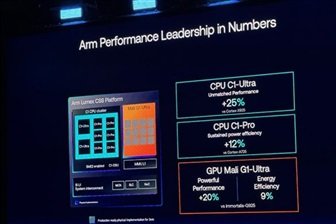
C1-Ultra: The industry’s largest microarchitecture, which boosts IPC by 12 %, provides 25 % higher single-thread performance, and has 28 % lower power than Cortex-X925. The 6.3 Geekbench results indicate a 26 % increase over Cortex-X925 at lower energy costs.
C1-Premium: Arm’s first” sub-flagship” reduces core area by 35 % compared to C1-Ultra with L2 cache, allowing cost-effective 8-core designs that maintain comparable performance.
C1-Pro: A large core with energy efficiency that offers 11 % more performance or 26 % less power consumption than Cortex-A725, with real-world workloads demonstrating 16 % performance gains and 12 % less power consumption.
C1-Nano: Convenient and wearable, improving efficiency by 26 % and SPECint2017 scores by 5.5 %, with only a 2 % area improvement over Cortex-A520.
In comparison to DSU-120, the new C1-DS U ( DynamIQ Shared Unit ) manages heterogeneous cores with SME2 support, reducing typical power by 11 % and RAM wake-up energy by 7 % at the cluster level.
A top-end 2C1-Ultra + 6C1-Pro swarm has 25 days the die place of a standard 2C1-Nano setup, giving it 17 times the performance of a standard 2C1-Nano setup. The C1 cluster averages 30 % better performance across workloads, 15 % faster gaming and streaming speeds, and 12 % less power is used for daily mobile tasks.
Shoulder is credited.
SME2: CPU AI becomes true.
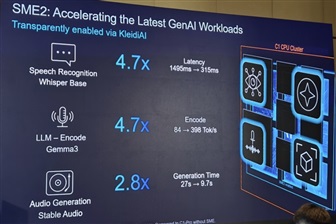
The CPU is transformed by SME2 into an Artificial pedal. It closes the gap between GPUs and GPUs for smaller AI things by enabling low-precision data types and effective column operations. According to Arm, SME2 offers 3 times better productivity and 5 times higher AI performance than the previous generation.
Sharp benefits are seen in measures:
Whisper Base’s talk recognition overhead dropped by 4.7 %,
Google Gemma 3 chat conclusion increased by 4.7 %,
Secure Audio era ran 2. 8 times more quickly.
On a single key, neurological camera denoising can achieve 120 fps at 1080p or 30 megapixel at 4K.
SME2 is already being used by companies like Alibaba, Ant Group, Samsung System LSI, Tencent, and Vivo, which highlights its contribution to the development of AI marketing.
Credit: ICsmart
Mali G1-Ultra GPU: cutting back on AI and light tracing
Leg fifth-generation GPU infrastructure, designed for mobile gaming and AI, is the Mali G1-Ultra GPU. The G1-Ultra redefines performance as mobile gamers now account for 83 % of the world’s entertainment community and log 390 billion hours annually.
Shows include:
RTUv2 ray tracing has a 20 % higher frame rate and 2x better performance than RTUv2.
● 20 % design boost,
Using MMUL, AI conclusion is 20 % faster. FP16, 104 % better FP32 ML output,
For longer gaming sessions, a 9 % lower per-frame power consumption is achieved.
For mid-tier industry, Shoulder also released the Mali G1-Premium and G1-Pro GPUs, which can support 1 to 24 shader components. First testing indicates that Fortnite, Honkai: Star Rail, and Genshin Impact all have substantial improvements to the G1-Ultra.
For developers, the GPU adds tile-based technology bars, Vulcan support, and upcoming RenderDoc integration for deeper monitoring. Fortnite Mobile‘s Armed Super Resolution ( ASR ), which is already available via Unreal Engine 5, enhances visual quality while keeping GPU load low.
Lumex CSS software includes developer tools, 3nm preparation, and system IP.
Lumex CSS is more than just Computers and GPUs. It incorporates method Internet and has been tested for 3nm process nodes at leading foundries, enabling chipmakers to create production-ready building blocks.
Compared to CI-7000, the SI L1 interconnect reduces leakage power by 71 %, reduces latency by 75 %, and integrates system-level cache with Memory Tagging Extension ( MTE ) support.
MMU L1 memory management system: Reduces TBU overhead by away to 83 %, enabling scalable, secure cloud for Windows and Android devices.
NoC S3 connection: Specifically designed for low-cost, non-coherent portable SOCs.
Leg KleidiAI collection has already been integrated into PyTorch and Llama on the application side. SME2-optimized Artificial performance is instantly delivered by party, MediaPipe, and more. Designers can adjust workloads before equipment launches with Android 16-ready bundles and observability equipment like Vulkan counters, Streamline, and Perfetto.
Business growth and deployment
No first design awards were made, but Vivo expressed curiosity on stage. Although not the entire Lumex CSS, analysts speculate that MediaTek’s Dimensity 9500 may choose the C1 CPU grouping and Mali G1-Ultra GPU.
Lumex CSS is a research system, not a bespoke SOC, according to professionals. To create business chips, OEMs must also incorporate NPUs, basebands, and software IPs.
Nonetheless, Lumex CSS offers pre-validated, 3nm-ready Internet that helps chipmakers decrease style cycles and reduce risk as AI becomes more advanced.
Lumex CSS combines C1 CPUs with SME2 and Mali G1 GPUs with RTUv2 to deliver mobile-grade games, conceptual AI, and real-time video. Finger positions Lumex CSS as the foundation for the AI-first-era’s next-generation flagship devices thanks to its strong ecosystem support, 3nm readiness, and total developer toolchain.
Edited by Jack Wu