

Frontend Development / “>Joab Jackson”>CSS Design: How to” Center a Div,” the Traditional Method. – The New Stack
What non-React equipment do you use the most frequently as a Script designer?
✓
Angular
0%
✓
Astro
0%
✓
Svelte
0%
✓
Vue.js
0%
✓
Other
0%
✓
I just use Relate
0%
✓
I don’t employ JavaScript.
0%
2025-12-16 08: 00: 04
CSS Design: How to” Center a Div,” the Traditional Method.
tutorial,
Centering content became challenging and time-consuming after the middle tag was removed from HTML 4.0 for structural purity. Before Grid or Flexbox, here’s how a whole generation of website designers did it.

The ( W3C ) deprecated the center tag in its support of when it updated HTML to version 4. 0 when it did so. Use convenience was sacrificed in favor of structural simplicity. And centering issues apparently became the state of .
There was nothing in location to instantly change the effective but structurally wrong center tag, which turned out to be problematic. None of the new layout elements ( header, nav, aside ) helped the coder properly proportion the elements on the page itself, despite the W3C’s list.
” Having studied network design, you will probably be amazed how complicated this all seems”! The Mozilla programmer page  truly stated what the online community initially embraced about the now-defunct methods.
Given that the canvas for an HTML webpage’s website is inexhaustibly eternal, it makes sense to put something in the “middle” of a website. It has no edges, it has no top or bottom. Therefore, the center must be defined by whatever paint the programmers use on the site ( if they are aware of how to do that at all ).
” Primitives work by giving things a length, and pushing them around to line them up in a way that looks like a network,” according to Divs.
–Mozilla Developer Network documents.
For a presumably political systems like the web, it was a lot of work. Before the and came down, many web designers went down a rabbit hole of distress that lasted for more than ten years.
Also, a whole generation of websites were built without Grid or Flexbox, and today are no doubt still some administrators who won’t touch the legacy and very fussy code for centering things, afraid that one excess or misplaced tag would collapse their whole site design.
Therefore, parts that were created from community-generated best routines can be centered on a web site using Grid or Flexbox. It all relies on tags, div>, and HTML <.
Divvy Up Is What Div Does
A portion, or sector, is defined by the HTML <, div>, label within a web document.
In the hierarchy of an HTML document, divs are the parts right next to <, body>, just as <, body> follows <, head>, and is arranged hierarchy-wide beneath <, html>, label.
You can think of each <, div>, <, /div>, set as a sort of a container, with which you can style with CSS ( or manipulate with JavaScript ), by adding a or <a href="https://www.w3schools.com/html/html_id.asp" =”ext-link” rel=”external”>id attribute of the <, div>,. The group can be applied to more than one <, div>, while the key attribute only refers to one particular <, div>, of a net page.
So a group name may be given to <, div>, and the browser will carry out that action for each and every member of the class.
IDs , operate in a similar way, except they use , names by hashtags rather than a single major circle.
Therefore, using the tags a , <, div> to establish a material area is the simplest way to center a certain amount of content on a page.
Some devs actually refer to this as <, div>, or a vessel, as Kevin Powell <a href="https://www.youtube.com/watch?v=ULVu2VNM_54" class=”ext-link” rel=”external”>explains in this instructive video. Using class or id, they then set the width of that container to 50 % ( half ) of the allotted size of that webpage. The box stays at the corresponding 50 % as the computer window’s size changes.
Set lengths in pixels can also be used to set the CSS height property, though changing the window’s size can cause issues.
In the script snippet above, the percentage house spaces the words from within the box factors. The space above and below the text is set by the first number (” 0″ ), and the second ( set here as “auto” ) is the between the right and left. If necessary, these profits may be specified more precisely with measures or percentages.
Make sure any classes called are done so in dumb quotes (” ) not smart quotes.
The sample text on the site is rendered in the center of the preceding code:
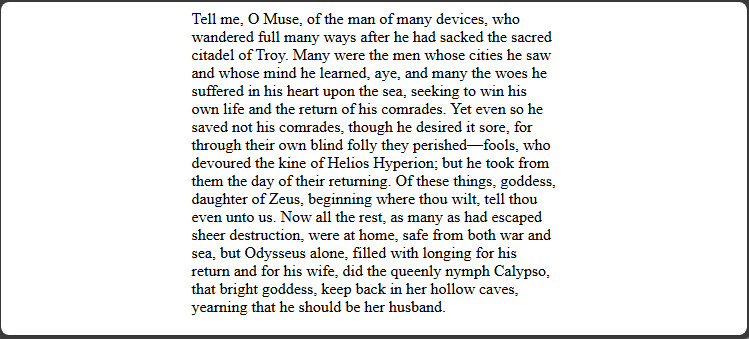
Crazy that is the simplest approach to center a page that is accessible to all sites.
Most website designers require more concentrating than that, alas.
Balance Multiple Columns in a Browser Window
But first, a trip into the CSS fly property’s world. The fly home was originally designed for positioning pictures inside of containers. If the graphic be aligned with the box or the image if it was smaller, or should it be angled up or down?
However, internet developers who were hungry discovered that float can be used to place any HTML element. Specifically, it may place smaller <, divs>, within the box <, div>,.
Two primitives, one floating left and the other floating to the right, can make up a two-column web site. They must be proportioned in a way that is proportionate to the size of the container, or they will crowd out and keep your site completely uneven, like too many cats do in a feeding bowl. You have to find out those statistics yourself.
In the example above, the container is set to take up 48 % of the container’s 100 %, and two divs are set to use the values <, div>, respectively. One is floated to the straight, and one to the left, according to the rules.
Here is how the below code makes on the page:

Note that a update, called , may be added, even as a <, div>, because of a faulty way the browsers purchase the measurement calculations of sizing. Although I’m not sure how it works, W3C recommends it.
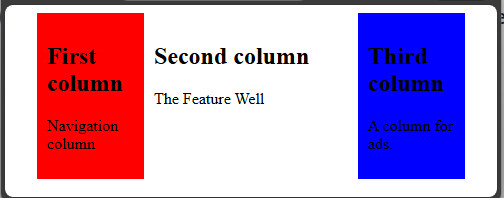
What about three columns, the favored for many websites ( including TNS itself, with the help of )? Playing around with the qualities of the namespaces and seeing how they stack up in the browser window is the best approach.
In the above example, both the right and left columns are given fly information to move them to the right and left, both, while the middle column is not, so it lands in the middle.
Also in the below code is a new group called paragraph, which allows the <, dev>, to identify characteristics that are the same across all the columns. Take note of the numerous classes that can be used to define each element. “is truly two courses,” the left column.
The code below will render likewise:
We may cover this in upcoming courses because different row layouts can be rendered with and/or more simply today. However, for the time being, you can be proud to be one of the several designers who is knowledgeable about centering a <, div>, and other <s.