

Europe’s Changing Nuclear Landscape: French Forward Deterrence – Center for Security Studies | ETH Zurich
French forward deterrence is a valuable contribution to European nuclear deterrence, even if its success depends on the continuation of NATO extended nuclear deterrence arrangements. Effective implementation hinges on building strong foundations that can withstand political changes and developing complementary and interconnected mechanisms with European allies.
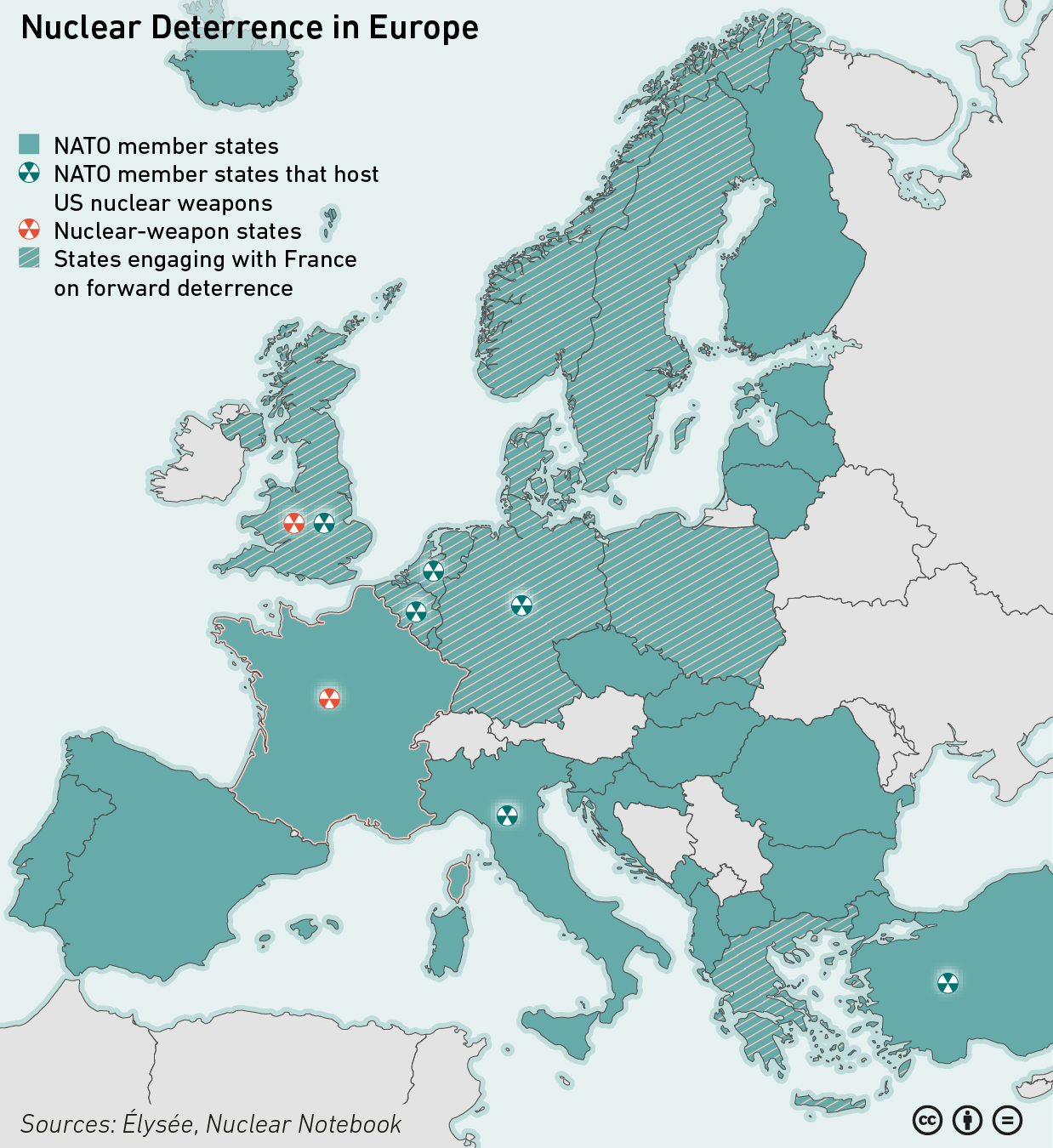
On 2 March 2026, French President Emmanuel Macron the second nuclear speech of his presidency, outlining several significant changes to French nuclear policy. These notably include an increase of nuclear warheads and a new framework for enhanced cooperation with European allies known as forward deterrence (dissuasion avancée). As of June 2026, nine European states have agreed to engage with France in structured bilateral discussions within this framework: the UK, Germany, Belgium, the Netherlands, Denmark, Poland, Sweden, Greece, and Norway. Additional states may join at a later stage.
These developments have to be understood in the context of a drastically different geopolitical and security environment from February 2020, when French nuclear policy was last updated by President Macron. In particular, the return of high intensity warfare to Europe following Russia’s full-scale war of aggression against Ukraine, combined with a second Trump administration that has repeatedly cast doubt on US security guarantees to NATO allies, has lent new urgency to calls for strengthening the European pillar of deterrence and filling perceived deterrence gaps.
While forward deterrence opens pathways to increase allied participation in French nuclear deterrence, it does not provide concrete alternatives in case of a severe weakening or collapse of US extended nuclear deterrence arrangements within NATO, or, indeed, of NATO deterrence as a whole. Macron framed it as complementary to NATO, and French officials this position with US partners prior to the speech, recognising many allies would be reluctant to engage openly and formally without US support.
This Policy Brief examines the implications and limitations of French forward deterrence within the context of evolving deterrence needs and perceptions in Europe. It first unpacks the concept of forward deterrence, then assesses the state of US extended nuclear deterrence arrangements within NATO, before turning to cases of several European states with which France has signed new cooperation agreements. This Brief argues that forward deterrence provides concrete and carefully measured contributions to a more European culture and practice of nuclear deterrence, while not fundamentally altering its core reliance on NATO’s extended nuclear deterrence.
Forward Deterrence: Institutionalisation with Limitations
While France has recognised the since 1972, the concept has lacked concrete mechanisms for implementation and buy-in from the affected allies. Macron’s March 2026 speech went beyond rhetoric and operationalised this commitment, which is now termed as forward deterrence. The concept is grounded in structured frameworks for bilateral political dialogue with new partners, with the aim of developing joint threat assessments and escalation management. Further measures include visits to nuclear sites, observing and taking part in joint nuclear exercises, and – most novel – the potential temporary deployment of French nuclear-capable fighter aircraft on allied territory.
Macron was also explicit about the strict limits of forward deterrence. Namely that ultimate decisions, planning, and employment conditions of nuclear weapons would remain in the hands of the French president. The definition of what constitutes a vital interest would also not be shared, meaning only the French would decide what targets, if hit, would justify a nuclear response or not. The French nuclear arsenal would also retain an exclusively strategic purpose, which excludes scenarios of nuclear use on the battlefield or “flexible nuclear responses”. He further underlined the strict separation of nuclear and conventional domains, while acknowledging “mutual support between nuclear and conventional capabilities”. When outlining allied contributions to forward deterrence, these are all conventional areas that are key for escalation management under the nuclear threshold: early warning, air defence, and deep strike capabilities.
Overall, forward deterrence provides a cohesive framework for allies to better understand and participate in French nuclear deterrence, grouping various earlier initiatives under one institutional umbrella. The possible deployment of nuclear-capable aircraft, potentially with a nuclear-armed missile during a crisis would provide signalling opportunities and extend the reach of French nuclear forces, further complicating adversary responses. By preserving core elements of French doctrine – sovereignty over nuclear forces that are intended for strategic purposes only – Macron has also preserved domestic consensus, which could enhance the longevity of this initiative beyond his term. However, several criticisms can be raised that forward deterrence is insufficient. Macron specifically highlights that there will be to allies so as not to lower the nuclear threshold. This may be to assuage domestic concerns, but when combined with the fact that only France ultimately knows what its vital interests are, this understandably creates doubts for many allies.
The novelty of potential deployments abroad of nuclear assets may offer and targeting dilemmas for adversaries, contributing to the improved survivability of France’s air force in a crisis. However, it would also open allies to direct retaliation. Because these deployments are temporary, they the same level of infrastructure – particularly regarding nuclear safety and security – as the permanent basing seen in NATO’s nuclear sharing arrangements. However, even temporary deployments may require . Yet France remains outside the NATO Nuclear Planning Group (NPG), closing itself off from coordinating nuclear policy with all NATO allies in one multilateral setting. The latter also underscores the fact that coordination with the nine interested allies so far will be managed on a bilateral basis. This is a deliberate approach to avoid creating competing mechanisms alongside the NATO NPG. However, it also risks creating a fragmented network of individual partnerships that may vary significantly in depth and scope.
“While forward deterrence opens pathways to increase allied participation in French nuclear deterrence, it does not provide concrete alternatives in case of a severe weakening or collapse of US extended nuclear deterrence.”
Névine Schepers
By framing forward deterrence as complementary to, rather than in competition with, US extended nuclear deterrence arrangements under NATO, French officials have attempted to allay the concerns of allies who fear antagonising Washington. Even amid a crisis of credibility, the US commitments to NATO remain crucial for European deterrence.
NATO: Conventional Retrenchment, Nuclear Reinforcement
US President Donald Trump’s scepticism towards NATO and his transactional approach to alliances were already evident during his first term, creating doubts about the reliability of US security commitments to European allies in a crisis. This uncertainty has deepened in his second term, driven not only by continued critical rhetoric towards allies, but also by coercive tactics, such as the regular threats of annexing Greenland and attempts to leverage US security guarantees to force European states to support US operations against Iran.
While rhetorical signalling , until recently allies could still be reassured that this did not translate into actions affecting US capabilities and military posture in Europe. However, since May 2026, US officials have announced several measures intended to limit US personnel and capabilities in Europe. These include the of approximately 5,000 US troops stationed in Germany over the next 6 to 12 months, which may be further increased, the of a planned deployment of long-range missiles to Germany, and reported to the number of capabilities that would be made available in a crisis, such as fighter aircraft and submarines.
This significant conventional retrenchment contrasts with the continued US emphasis on NATO’s nuclear mission. Senior officials such as Under Secretary of Defense Policy have reaffirmed the importance of US extended nuclear deterrence commitments. To date, nuclear capabilities and the institutional frameworks underpinning NATO’s nuclear posture have not been directly affected by cuts. Moreover, significant allied investments in dual-capable F-35A aircraft have reinforced the operational viability of the nuclear mission. The modernisation programme for the US nuclear gravity bombs deployed across six bases in Europe (located in Germany, Belgium, Italy, the Netherlands, and Turkey) was completed in early 2025. Additional US warheads may have also already been deployed to the UK, as the country rejoins NATO nuclear sharing arrangements. Recent have even raised the possibility of expanding US deployments of nuclear weapons to other countries in Europe, most likely on NATO’s eastern flank, such as in Poland and .
The Trump administration’s divestment from NATO’s conventional capabilities, alongside its continued and potentially expanded commitment to extended nuclear deterrence mechanisms, suggests a greater reliance on nuclear capabilities within NATO. This shift has several implications for European states, given that relies on “an appropriate mix of nuclear, conventional and missile defence capabilities.” Fewer boots on the ground, less conventional options deployed or available in a crisis, and disparaging rhetoric all put a strain on the overall credibility of NATO’s deterrence. They also reduce the number of options available in different confrontation scenarios with Russia, risking increased nuclear signalling and possibly rapid escalation. Furthermore, some experts that this may encourage Moscow to test NATO’s escalation dominance, which could leave NATO vulnerable.
Ultimately, the coherence and durability of long-term US commitments toward NATO, including its nuclear mission, remain uncertain. The current administration appears to favour sustaining nuclear assurances while reducing conventional commitments, which is likely a reflection of resource allocation to other theatres and efforts to further pressure European allies to increase their share of the burden. However, these strategic priorities could change quite rapidly again.
Even if premised on the continuation of US extended deterrence commitments, France’s concept of forward deterrence at least provides some pathways to strengthen European cohesion on nuclear deterrence, particularly with the nine NATO states that have so far chosen to take part.
“The significant conventional retrenchment contrasts with the continued US emphasis on NATO’s nuclear mission.”
Névine Schepers
In or Out: Partnerships under Scrutiny
A closer look at some of the European partners that have agreed to deepen their cooperation with France up until early June 2026 reveals different interests. It is also telling as to which states have not (yet) signed up to the initiative. President Macron has explicitly positioned the UK and Germany as key allies in this framework, while maintaining an open-door policy for other allies. Cooperation with the UK, Europe’s only other nuclear-weapon state, was reinforced in July 2025 with the signing of the , which established a formal nuclear steering group to coordinate nuclear policy, capabilities, and operations. This Franco-British axis is perhaps the most important for strengthening the nuclear elements of European deterrence. While the alignment between Paris and London lends more credibility to reassurance claims, the implementation measures remain unclear and limitations exist due to the UK’s for its submarine-launched ballistic missiles, on which its deterrent entirely relies.
On the same day as Macron’s speech, a second steering group with Germany was announced, setting the tone for cooperation with other allies. Historically, Berlin’s to discuss nuclear issues outside of NATO, where it holds a privileged position as a country with dual-capable aircraft (DCA) contributing closely to the NATO nuclear mission, has proved to be a long-standing barrier to establishing nuclear talks with France. However, for other NATO allies that share similar concerns about French proposals potentially alienating the US, Berlin’s newfound willingness to engage with Paris lends credibility to forward deterrence, also through Germany’s ability to provide the necessary conventional elements to reinforce it.
“France’s concept of forward deterrence at least provides some pathways to strengthen European cohesion on nuclear deterrence.”
Névine Schepers
Belgium and the Netherlands, two other NATO allies with DCA capabilities, also feature among the nine partners. This provides further complementarity with NATO, yet also highlights the absence of Italy, which may be because of rather than a lack of willingness to cooperate. Italy has previously participated in French nuclear exercises and is a member of the European Long-Range Strike Approach (ELSA) project to support the joint development of deep strike capabilities.
Poland’s participation follows logically from the May 2025 Treaty of Nancy, which contained a mutual defence clause with France. Moreover, Warsaw’s significant conventional investments make it a valuable partner for Paris. Warsaw may prioritise NATO frameworks, perhaps by even becoming a country that operates DCA and a host for further US nuclear weapon deployments, but seems to actively pursue a multi-layered strategy to maximise its deterrence posture vis-à-vis Russia. Hosting French nuclear exercises on its territory would send a strong signal to Moscow. The current absence of any of the three Baltic states from forward deterrence partnerships is a notable omission, though it may simply be a matter of when rather than if they join. Given the Baltic states’ exposure to Russian threats, they may also prefer to double down on NATO frameworks and the cohesiveness they provide.
“While pushing for complementarity with NATO extended nuclear deterrence frameworks, Paris also ensures that allies are willing to engage and do not fear duplication or alienation from Washington.”
Névine Schepers
Cooperation with Sweden, Denmark, and Norway signals the continuation of a in Nordic countries, which traditionally supported arms control and disarmament initiatives. While all three still maintain peacetime prohibitions against the permanent stationing of nuclear weapons on their territories, this does not necessarily preclude the temporary deployment of nuclear-capable aircraft, with or without a nuclear weapon, in a crisis. From an operational perspective, access to the northern flank and the Arctic allows for geographical dispersal and enables France to pose a threat to a wider range of Russian strategic targets. This provides for French nuclear planning and operational flexibility. Finland, as a key Nordic outlier, is in talks with France about joining the initiative.
Outlook
France’s new forward deterrence concept threads the needle of offering new ways for willing allies to closely engage with and conventionally support French nuclear policy and its commitment to European deterrence. At the same time, it also preserves French sovereignty and control over its arsenal and posture, while ensuring complementarity with NATO. By balancing so many different interests, it runs the risk of falling short on all fronts. Those that hoped for flexible response options that would break with French doctrine will be just as critical as those that sought to keep nuclear policy firmly cemented in its Gaullist tradition.
While pushing for complementarity with NATO’s extended nuclear deterrence frameworks, Paris also ensures that allies are willing to engage and do not fear duplication or alienation from Washington. Yet, reliance on the continuation of NATO’s nuclear sharing mechanisms could become problematic in case of US disengagement. Should the NATO framework fracture, or should the US impose excessively onerous conditions on its allies, French complementary mechanisms would prove fundamentally inadequate on their own.
Ultimately, the success of forward deterrence will hinge on at least three different factors. First, ensuring that clear expectations on all sides are set and met. This will be challenging if one considers the difficulties of various conventional projects France hopes to see progress on. Second, where possible, integrating the different bilateral arrangements into broader consultations or exercises to help avoid a divide-and-rule approach and the emergence of visibly tiered partnerships. Third, efforts should focus on building strong foundations capable of withstanding potential political changes ahead of the 2027 French presidential elections.
JavaScript has been disabled in your browser